

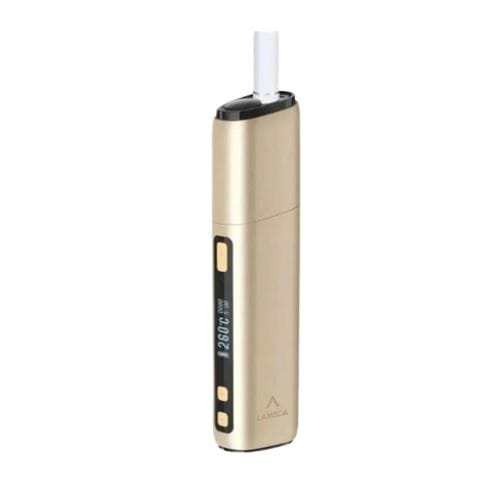
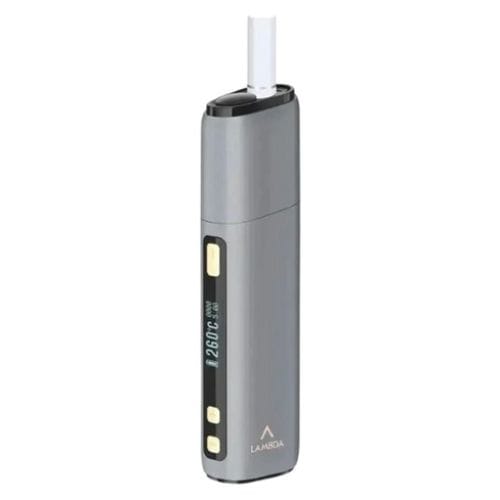

Grey is the understated professional in the Lambda CC range, the finish that hides fingerprints best of the six and passes without comment in any setting.
The device is the standard CC: titanium steel alloy heating blade, OLED HD display, 200 to 300°C adjustable, 3 to 6 minute sessions, 3200 mAh battery, magnetic cap, 73 grams.
Auto Cleaning on a Blade: What It Actually Does
The induction side of the Lambda family markets self-cleaning as a convenience. On a blade device, cleaning is not a convenience topic; it is the difference between a long-lived device and a dead one, because aggressive manual cleaning is historically what killed blades. So the CC’s auto-cleaning function deserves a proper explanation rather than a bullet point.
The problem it addresses. Every blade session leaves a film of baked residue on the blade itself, the direct-contact byproduct that induction devices simply do not have. Left to build, it does three things in sequence: flavour drifts first, as old residue bakes again with every new stick; then sticks seat and release less cleanly; and finally owners reach for aggressive tools, which is the step that used to end devices. The old IQOS routine of cleaning sticks and brushes existed entirely to interrupt that sequence by hand.
⚠ The Residue Sequence, Interrupted
Blade residue left alone runs a three-step sequence. The auto-clean exists to break it at step one.
First: flavour drifts
Old residue re-bakes with every new stick, and a familiar HEETS variant starts tasting off. This is your early signal, and it arrives before anything mechanical is at stake.
Then: sticks seat and release badly
Buildup narrows the space around the blade, insertion tightens, removal gets less clean.
Finally: the dangerous step
Owners reach for picks and force, the step that historically ended blade devices. On the CC this step should simply never arrive.
The interruption
Auto-clean at the flavour-drift stage, empty chamber, self-cleaning-oven principle: residue burns to loose material, a cool gentle sweep clears it, and steps two and three never happen.
What the cycle does. Run with no stick inserted, the auto-cleaning function takes the blade through a heating cycle that burns the residue film off, carbonising it to loose material that a brush-out or tap then clears. It is the same principle a self-cleaning oven uses, applied to the one component that must stay clean. The large heating space the CC is built with works alongside it: more clearance means buildup accumulates slower and the brush reaches everything without pressing against the blade.
Where the brush still fits. The cycle handles the blade film, which is the dangerous residue. The brush, supplied in the box, handles the loose remainder: carbonised material after a cycle and stray tobacco around the chamber floor. Its job on the CC is gentle sweeping, not scraping, and if brushing ever feels like it needs force, the correct response is another cleaning cycle, never a harder tool.
🧹 Who Cleans What: The Cycle and the Brush
Two tools, a clean split, and one rule about force.
| The auto-clean cycle Owns the blade film, the dangerous residue. Burns it to loose carbon on the manual’s interval, empty chamber, display supervising. The heavy work, done by heat. | The supplied brush Owns the aftermath: carbonised material post-cycle, stray tobacco on the chamber floor. Gentle sweeping, device cool, every pack or two between cycles. |
The force rule
If brushing ever feels like it needs pressure, the answer is another cycle, never a harder tool. Nothing metal goes near the blade on any day for any reason.
The rhythm that works. Auto-clean on the manual’s interval, brush-out afterwards once cool, and a light sweep every pack or two between cycles. Flavour drift on a familiar HEETS variant is the useful early signal that a cycle is due, and it arrives before anything mechanical is at stake.
The OLED HD display’s part in this. The CC’s display shows temperature, session time and battery, and during cleaning it shows the cycle’s status, which matters for one practical reason: it tells you the device is hot with no stick in it, exactly the state where an impatient hand goes to brush too soon. The display is bright enough to read outdoors, the same OLED advantage the Lambda i9 carries over its LED siblings, and on the CC it doubles as the cleaning cycle’s supervisor.
Against the old blade routine, the honest comparison lands like this: the 3 DUO demanded regular manual cleaning with the device’s life at stake each time; the CC asks you to press a function, wait, and sweep. The residue is inherent to blade heating and no device removes it; what the CC removes is the danger in dealing with it.
Technical Specifications
| Specification | Detail |
|---|---|
| Model | LAMBDA CC |
| Colour | Grey |
| Heating | Titanium steel alloy heating blade |
| Blade | Replaceable part |
| Display | OLED HD |
| Auto cleaning | Yes, blade heating cycle |
| Working temperature | 200 to 300°C, adjustable |
| Session time | 3 to 6 minutes, adjustable |
| Stick removal | Embedded magnetic cap |
| Battery | 3200 mAh |
| Heatsticks per charge | 35 to 40 |
| Input | 5V, 2A |
| Port | USB Type-C |
| Charge time | Approximately 2.5 hours |
| Dimensions | 106.5 x 29.5 x 21.5 mm |
| Weight | 73 g |
| Materials | PEEK, PPSU, PC |
| Sticks | HEETS, Marlboro HeatSticks, Parliament, Fiit |
| TEREA | Not compatible |
| Adaptor | Not included |
What Comes in the Box
- 1 x Lambda CC in Grey
- 1 x cleaning brush
- 1 x USB Type-C cable
- 1 x user manual
- 1 x QC card
Note specific to this colour: grey hides fingerprints and pocket wear best of the six, and hides chamber-area residue nearly as well as black does, so the same advice applies: run the cleaning rhythm on schedule rather than on sight.
How to Use It
- Charge fully before first use, around 2.5 hours over USB Type-C.
- Power on and check the OLED display.
- Set the working temperature, 200 to 300°C.
- Set the session time, 3 to 6 minutes.
- Lift the magnetic cap, insert a HEETS-format heatstick straight down, refit the cap.
- Start heating and wait for the ready indication.
- Use for the set duration. The session ends automatically.
- Lift the cap and remove the spent stick straight up.
Compatibility
HEETS in every variant, Marlboro HeatSticks, Parliament heatsticks and Fiit run here. TEREA is built for induction and does not go in a blade device; that format lives with the Lambda i8, i9, i10 and ILUMA i, with our TEREA range covering its flavours.
Storage and Care
Below 60°C always, never in a parked UAE car in summer. The cleaning rhythm above is the care that matters; the exterior asks a rare dry wipe, and grey forgives longer gaps between them than any other CC colour.
Other Colours
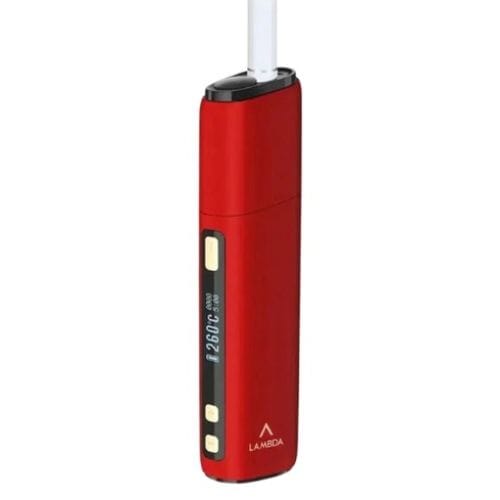
- Army Green, Black, Gold, Red and White
- The Lambda CC collection
- The induction family: Lambda i8, i9, i10 and the Lambda range
Delivery: Same-day delivery in Dubai, next-day across Abu Dhabi, Sharjah, Ajman, Al Ain, Ras Al Khaimah, Fujairah and Umm Al Quwain.
Frequently Asked Questions
How does auto cleaning work on a blade device?
With no stick inserted, the function heats the blade through a cycle that burns the baked residue film to loose carbonised material, which a gentle brush or tap then clears. It is the self-cleaning oven principle applied to the blade.
Does auto cleaning replace the brush?
No, they split the work. The cycle handles the blade film, the dangerous residue; the brush sweeps the loosened remainder and the chamber floor. What it replaces is force: brushing on a CC should never need pressure.
How do I know a cleaning cycle is due?
The manual’s interval is the baseline, and flavour drift on a familiar HEETS variant is the useful early signal. It arrives well before anything mechanical is at stake.
Can I brush right after the cycle finishes?
Cool first, always. The display shows the cycle’s status, which is exactly the reminder that the device is hot with no stick in it. Several minutes, then sweep.
Is the CC’s cleaning burden really lighter than an old IQOS 3 DUO’s?
Meaningfully. The 3 DUO’s routine was manual, regular, and dangerous to the blade each time. The CC’s is a function, a wait, and a sweep. The residue is inherent to blade heating; the danger in handling it is what got engineered away.
Does heavy high-temperature use change the cleaning rhythm?
It shortens it somewhat, since hotter sessions bake residue faster. If you live at the top of the 200 to 300°C range, expect the flavour-drift signal to arrive a little earlier between cycles.




Reviews
Clear filtersThere are no reviews yet.